
Nanotechnology & materials
Tian Xie
From the Bronze Age to today’s silicon-powered smartphones, virtually every massive leap in technology has been driven by breakthroughs in materials. But finding the right material for a particular application is tricky. Traditional screening methods, which must narrow millions of options down to a testable few, are like “finding a needle in a haystack,” says Tian Xie, 32.
Xie, a principal research manager at Microsoft Research AI for Science, wondered: Instead of sifting through databases of known materials, what if scientists could just tell an AI model what they wanted—and let the model find or create the perfect candidate?
His invention, MatterGen, attempts to do exactly that. Trained on over 600,000 stable materials and relevant quantum chemistry culled from two massive databases, MatterGen lets scientists specify the chemical, mechanical, electronic, or magnetic properties they’re looking for. Like image generators that transform visual noise into coherent pictures, MatterGen is a diffusion model that begins with a random atomic structure. It then gradually refines the “unit cell”—the smallest repeating unit of a material—by adjusting atom types, positions, and lattice patterns. Finally, it produces the recipe for a stable material meeting the desired criteria.
MatterGen: A Generative Model for Materials Design | Microsoft Research Forum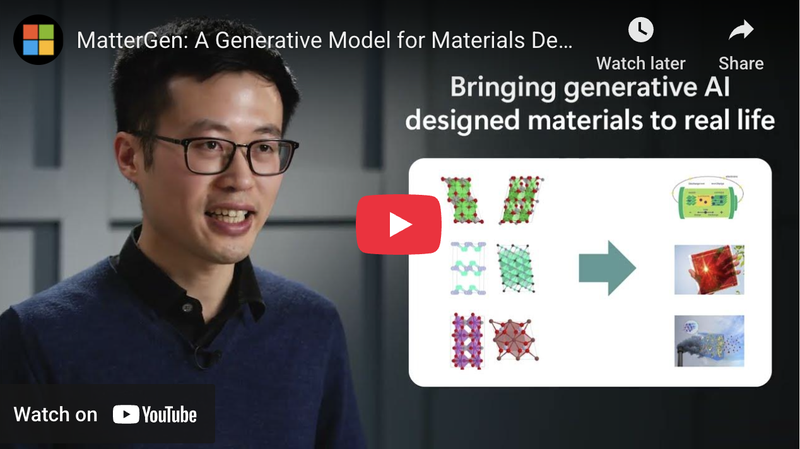
Because of its very large training pool and ability to discern what makes certain materials “good” at something, MatterGen particularly excels at designing materials with extreme traits, like high magnetic density or super hardness. Now, though, comes a critical challenge. Xie and his team will need to move beyond the digital and show that they can actually produce MatterGen’s creations in the lab—and that the resulting materials perform as expected. Many other AI models tasked with coming up with new materials have conjured plenty of hypothetical possibilities but struggled to generate useful results.
Early tests look promising. One material MatterGen suggested resisted compression within 20% of the model’s predicted value, a margin that Xie says is considered good for experimental validation. The team is now working with partners to synthesize and test more of MatterGen’s creations in the real world.
Xie sees MatterGen, which is open-source, as a way to supercharge material discovery, for uses like better batteries for electric cars or fuel cells for sustainable energy storage. Instead of searching for the next breakthrough, researchers might be able to design it on demand.

Global
Baodan Zhao

Asia Pacific
Phillip Grant

Asia Pacific
Chunsen Liu