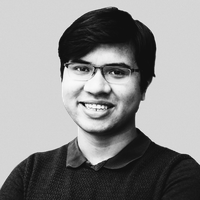
Photo of Ananye Agarwal

Artificial intelligence & robotics

Ananye Agarwal

Combining simulation data with Internet data to train a "universal brain" capable of controlling robots in different forms.
Year Honored
2025

Organization
Skild AI

Region
Asia Pacific

Ananye Agarwal's research focuses on addressing a core bottleneck for applying general artificial intelligence to the physical world: the scarcity of physical interaction data. He pioneered the use of large-scale simulation as a solution, allowing robots to be trained in millions of virtual worlds. This approach enables the rapid accumulation of vast physical interaction experience, which is then used to train general robot models capable of stable operation in the real world.

Using an end-to-end neural network trained entirely in simulation, he directly maps a robot's raw sensor inputs to motor commands. This approach enables low-cost legged robots to autonomously learn to navigate challenging terrains like stairs and rubble piles without human programming. In 2024, he extended this technology to robotic parkour, achieving difficult maneuvers such as jumping between platforms and traversing large obstacles.

To help robots better understand human intent, Agarwal explored combining simulation data with internet data. He proposed using internet data to provide robots with knowledge about the functional parts of objects, which is then combined with simulation training to teach them how to robustly perform grasps. This allows robots to "correctly" grasp tools like hammers and drills. He also led the design of the LEAP Hand, a low-cost, highly dexterous, open-source anthropomorphic hand that lowers the research barrier in this field.

To train a "universal brain" capable of controlling robots with varying morphologies, he developed the LocoFormer model. This model was trained on over 100,000 different robot designs, enabling it to adapt to extreme hardware failures such as broken legs or jammed motors. To support such massive-scale training, he and his team designed a novel distributed reinforcement learning algorithm named SAPG. He is now advancing the further extension and application of these technologies as a Founding Researcher at Skild AI.